| Why Total Alignment? |
How Hunter Digital Imaging Wheel Alignment Technology Work |
Reduce Tire Wear
Improper alignment is a major cause of premature tire wear. Over the years, a properly aligned vehicle can add thousands of miles to tire life. Most tires are replaced prematurely due to adverse wear. |
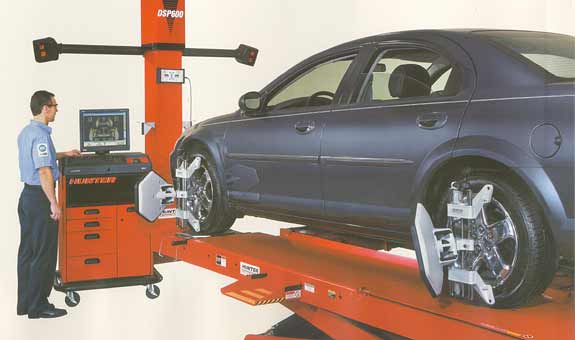
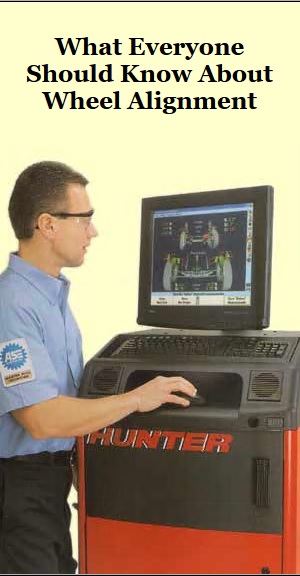
Hunter's DSP600 Picture Perfect digital imaging technology uses four precision cameras in the aligner "tower" to measure the position and orientation of reflection targets mounted on each wheel of your car. |
Better Gas Mileage
Gas mileage increases as rolling resistance decreases. Total Alignment sets all four wheels parallel, which along with proper inflation, minimizes rolling resistance. |
Hunter's DSP600 Picture Perfect digital imaging technology uses four precision cameras in the aligner "tower" to measure the position and orientation of reflection targets mounted on each wheel of your car. |
Improved Handling
Does your car pull to one side? Do you constantly have to move the steering wheel to keep your car traveling straight ahead? Many handling problems can be corrected by Total Alignment service. With all the vehicle components aligned properly, road shock is more efficiently absorbed for a smoother ride. |
 |
Safer Driving
A suspension system inspection is part of the alignment procedure. This allows worn parts to be detected before they cause costly problems. |
The aligner computer uses this information to calculate your car's current alignment measurements and then compares these measurements to tge car manufacturer's (O.E.M.) alignment specifications. alignment specifications. |
Here's What We Do: 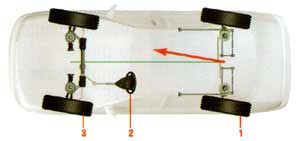 For vehicles with non-adjustable rear suspension: For vehicles with non-adjustable rear suspension:
1. Alignment angle readings are measured at all wheels.
2. The steering wheel is centered.
3. Adjustable front wheel alignment angles are referenced to the rear thrust line and set to the vehicle manufacturer's specification.
Result: all four wheels are parallel to one another and the steering wheel Is centered. |
If it determines that your car's wheel alignment is outside factory specifications, the aligner provides the technician with the exact information needed to make the proper adjustments and return the alignment angles to the 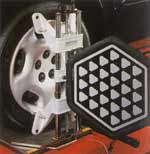 manufacturer's specifications. manufacturer's specifications. |
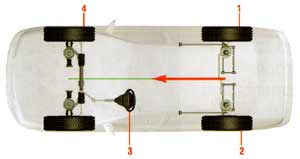 For vehicles with adjustable rear suspension: For vehicles with adjustable rear suspension:
1. Alignment angle readings are measured at all wheels.
2. Adjustable rear alignment angles are set to the manufacturer's specification. (Rear thrust line corresponds to vehicle centerline.)
3. Steering wheel is centered.
4. Adjustable front wheel alignment angles are referenced to the rear thrust line and set to the manufacturer's specification.
Result: all four wheels are positioned straight ahead and parallel, and the steering wheel is centered. |
This imformation about Wheel Alignment is provided courtesy of:  |
This Can Happen To Any Vehicle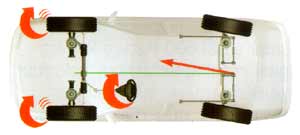
On this vehicle, the front wheels are not aligned to the rear thrust line. This can happen from normal wear and stress, whether your vehicle has adjustable or non-adjustable rear suspension.
To travel straight ahead, you would have to steer the front wheels slightly to the right.
A common result would be that the vehicle would "dog track" and possibly "pull" to the side.
Of course, the angles are exaggerated so you can more easily see the condition. It takes only a small amount of misalignment to create handling problems and cause rapid tire wear. |
|